Question:
I know that you're supposed to loop the hair between your thumb and index finger before you begin the ventilation process... I was wondering if the loop is supposed to be even meaning if the hair is 24 inches long originally, will it be 12 inches as you ventilate it or does it not matter?
For total beginners - When you ventilate you need to create a curve (loop) in order to catch the hair in the ventilation needle, which means you can then pull it through the lace hole and do your knot. This is achieved by folding over the top of the length of hair where the root end is - remember the hair you buy and use needs to be cuticle correct or it will tangle and matt up when the wig is worn/washed.
To help keep your bulk, raw hair organised, use a pair of drawing cards. Write 'root' at the top, and always place the hair you are using with the root end lying at the end marked root on your drawing cards. You should be able to tell the root end when you buy the hair, as the hair is usually bound more strongly and obviously at the root end. Depending on how the hair was collected, you can also tell by looking at both ends: one end will normally look 'cut'.
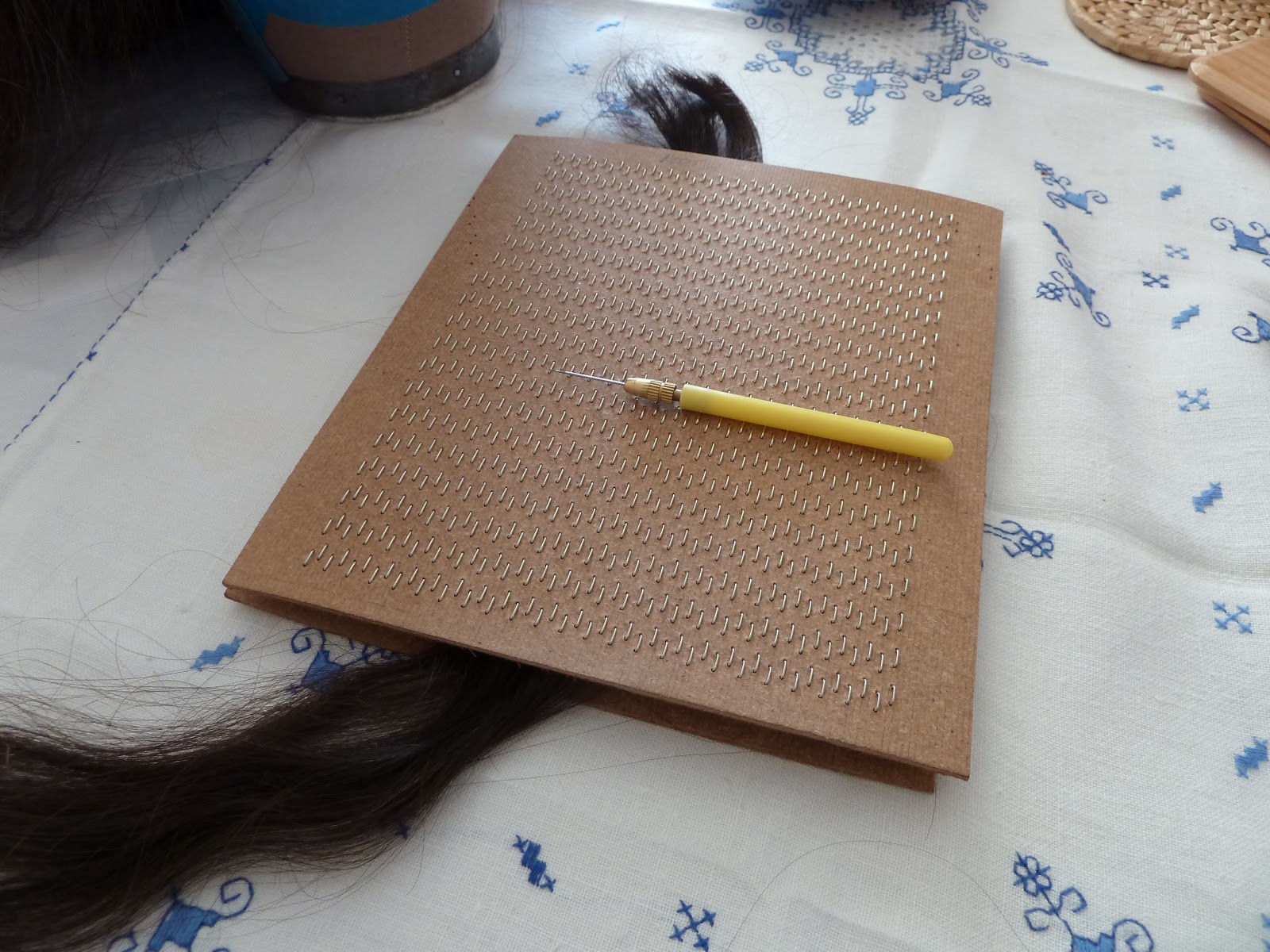
Drawing Cards
Tip: Hold them together with an elastic band or a pair of clamps. If the cards fall on the floor, they may fall apart and all the hair get mixed up in different directions, which would make the hair unusable.

Root End Marked

Drawing Cards - The 'Teeth' Hold the Hair in Place and You 'Draw' a Small Amount Out to Ventilate

Hair Folded Over to Make a Return

The Loop - this is the holding position for ventilating. Hold the folded loop together between your thumb and index finger. Then draw hairs from the loop through your lace, monofilament or tulle.
Tip: don't take too much hair at a time from your drawing cards or you might get finger fatigue from trying to grip it all! This also helps to prevent hair wastage when learning, as you may drop some or find it gets caught up and need to chuck it in the bin if the root to tip becomes mixed up.

Question:
Also, how much hair is needed normally for a lace front wig? (100-120% density)
How much hair you will need depends on how long the hair is, as even for the same density, the longer the hair, the heavier it will be.
Length - remember that you will lose at least 1 inch for the return; however, I bank on losing 2 inches (I am a cautious person). Then, you need to take into account whether you will want to have the wig cut after you made it. If you do, you will lose maybe another inch or two. So if I want to make a wig that is 12 inches long, I would buy a minimum of 14 inches, maximum 16 inches in length.
To get a length of 14 inches, to be cut down to 12 or 13 inches finished length after styling - I personally would be looking to buy between: 170/180 grams (14 inches) to 190/200 grams (16 inches) of raw, bulk hair. This is about 6 to 7 ounces. I like to allow for a little wastage, so would tend to round up rather than down. With a bulk hair vendor, you can usually buy in small increments - certainly in the UK you can buy by the 10 gram increment.
I have tried to think how to make some kind of formula for this. The best I can come up with (I hope this works! BUY AT YOUR OWN RISK - double check with the hair vendor, as they should also be able to advise how much you need) is:
For every increase of 2 inches, add 20 grams, for every decrease of 2 inches, remove 20 grams. This is approximate, it depends on the thickness of the hair (think about it, if the strands are finer, you will get more strands than if they are thicker!). The range gives you a little adjustment because if you end up with raw ponytails, you may find you cannot add them together to weigh exactly 160 or 220 or whatever. I would tend to favour the upper number, better to have too much than too little and, in my case, I have a big head so more foundation to cover (hehe).
10 inch wig: you would need at least 12 inches of hair, you would want to order 150/160 grams.
12 inch wig: you would need at least 14 inches of hair, you would want to order 170/180 grams.
14 inch wig: you would need at least 16 inches of hair, you would want to order 190/200 grams.
16 inch wig: you would need at least 18 inches of hair, you would want to order 210/220 grams.
18 inch wig: you would need at least 20 inches of hair, you would want to order 230/240 grams.
Converter: http://www.metric-conversions.org/weight/grams-to-ounces-table.htm
Generally, if you are buying bulk hair from a supplier like De Meo Brothers (US) or Hugo Royer (UK), it is a good idea to buy a little extra hair for repairs and/or in case you misjudge how much you need. The upside being, the more wigs you make, the more hair you will have in stock (assuming you don't use all the hair each time you make a wig) and you can eventually gather compatible colours together, and blend them to make a hair piece or wig if you want to.
Density - If you want a heavier density wig, then add on another 25-30% so:
Medium density weight x 1.25 (to add 25%)
Medium density weight x 1.30 (to add 30%)
I hope this helps.
Disclaimer: Buy at your own risk. I accept no responsibility for these numbers being inaccurate!
